
Service
Process Engineering & Operational Efficiency
Fix how work actually happens — so systems and automation amplify results instead of chaos.
Ideal for: Organizations scaling rapidly, post-merger integration, or struggling with manual processes.
The work
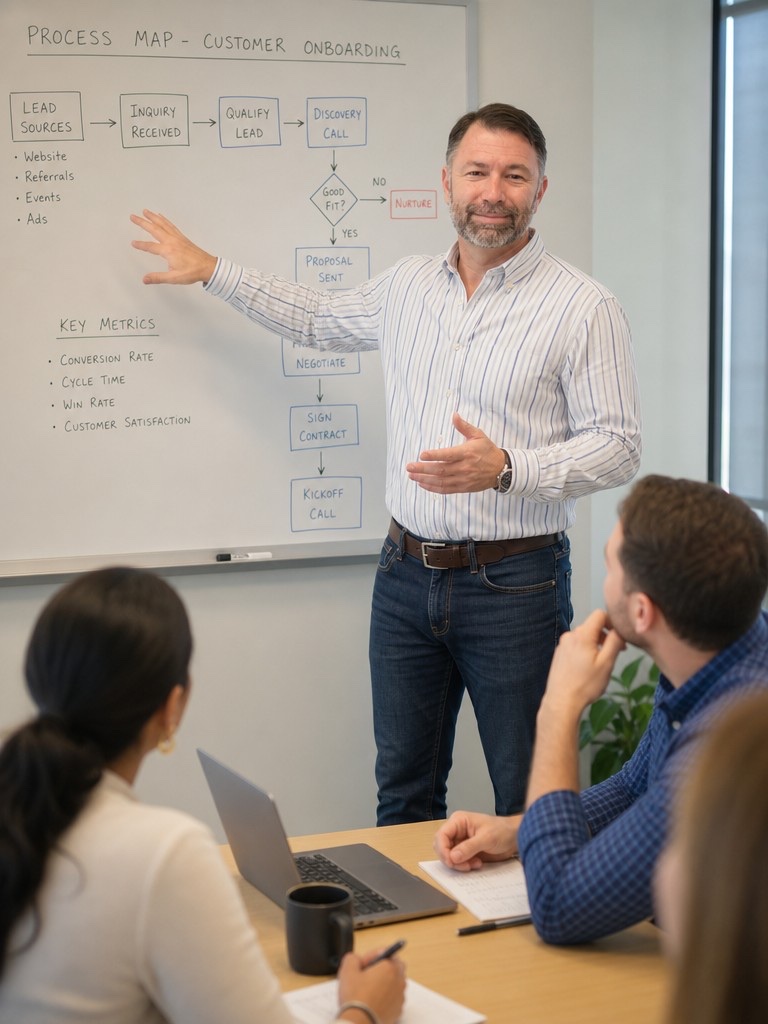
Before software, we map the work. Foundation5 finds where process breaks outcomes — then redesigns workflows so people and platforms can scale without proportional headcount.
Capabilities
What we deliver
- Current-state swim lanes, RACI, and handoff maps
- Future-state workflow design with measurable KPIs
- Quick-win backlog plus structural fixes sequenced for adoption
- Training for Marketing, Sales, Billing, and Support owners
- Continuous improvement cadence and health-check retainers
Technologies
Process Engineering & Operational Efficiency
Map current state, design future workflows, then automate — so tools amplify good operations.
In depth
How we approach Process Engineering & Operational Efficiency
Overview of Process Engineering & Operational Efficiency
Before software, we map the work. Foundation5 finds where process breaks outcomes — then redesigns workflows so people and platforms can scale without proportional headcount.
Ideal for: Organizations scaling rapidly, post-merger integration, or struggling with manual processes.
Problems we solve
Manual rework, unclear ownership, and habit-based approvals consume headcount while customers wait. Teams buy automation hoping tools will fix flow — and scale the mess. Foundation5 process engineering finds where work actually breaks outcomes, then redesigns so people and platforms can scale without proportional hiring.
Process engineering before automation
Engagements start with mapping how work flows today: who touches each step, where data is re-keyed, which approvals exist for policy versus habit, and where errors require rework. That baseline often shows technology is not the first lever; clarifying ownership and removing unnecessary steps delivers immediate savings.
Once the future-state process is agreed, we identify automation candidates with clear ROI: workflow rules, integration-triggered updates, self-service portals, and AI-assisted routing. Subsplash scaled processing fivefold during pandemic-driven demand without proportional hiring because we redesigned billing and fulfillment first, then implemented Salesforce and Stripe to match.
Continuous improvement does not end at go-live. We help operations leaders establish KPI reviews, exception handling playbooks, and quarterly process retrospectives so gains compound. Methods: process mapping before automation and baseline cycle time.
Deliverables and who we serve
Deliverables include current- and future-state maps, RACI matrices, automation specifications, training materials your team can maintain, and KPI baselines finance can defend. Ideal for high-growth SaaS, post-merger integrations, and professional services firms where time and invoice reality disconnect from CRM.
Foundation5 facilitates across sales, finance, support, and IT so handoffs are accountable. When meeting-to-CRM AI is next, we sequence it after ownership is clear — meeting-to-CRM after process mapping.
Capabilities and deliverables
Every engagement is scoped to your timeline and internal capacity. Representative deliverables:
- Current-state swim lanes, RACI, and handoff maps
- Future-state workflow design with measurable KPIs
- Quick-win backlog plus structural fixes sequenced for adoption
- Training for Marketing, Sales, Billing, and Support owners
- Continuous improvement cadence and health-check retainers
Related services and proof
Explore adjacent practices that often travel with process engineering.
Related case studies


5x scale with same headcount
Subsplash
Scaled billing and processing fivefold during pandemic demand with Salesforce billing and Stripe — without proportional headcount.
Read More →


~$1.8M/year savings
Fuhu / Nabi
Restructured global IT for an Inc. 500 #1 company, saving roughly $150k per month (~$1.8M annually).
Read More →


Unified data layer across tools
Oversee
Architected a reusable data layer and workflow engine so domain monetization tools shared one source of truth.
Read More →
Related articles
Practitioner notes that pair with this practice — process, adoption, and AI readiness.
Operations · 7 min read
Process Mapping Before Automation Spend
Automating a broken process scales the mess. Map current-state work, remove rework, then apply AI or systems — so automation earns the outcome you named.
Operations · 5 min read
How to Baseline Cycle Time Before Automation
Measure median cycle time, rework, and volume per FTE before buying automation — so ROI is defensible to finance.

Operations · 5 min read
Remove Approvals Before You Automate Them
Habit vs policy approvals are free wins — automating rubber stamps scales waste. How to cut before you configure.
FAQ
Questions about Process Engineering & Operational Efficiency
Straight answers about how we approach this work and what to expect.
Where do you start with process engineering?
With how work actually happens today — not the org chart. We map current-state process, find where data gets re-keyed, where approvals exist out of habit rather than policy, and where rework absorbs headcount. Automation and systems come after that baseline is agreed.
Do we need new software before you can help?
No. Some of our highest-ROI engagements remove steps or clarify ownership without buying anything. When a tool is warranted, we recommend it because it earns automation — not as the default answer.
How do you measure process improvement?
Against baseline metrics agreed before the work starts — cycle time, cost per transaction, headcount per unit of volume, or error and rework rates. Subsplash scaling processing 5x with the same headcount is the kind of result we design toward.
Can you work alongside our existing operations team?
Yes. We facilitate cross-functional workshops and hand off process maps, RACI matrices, and training materials your team can maintain — augmenting internal capacity rather than replacing it.
Schedule a consultation
Talk to us about process engineering & operational efficiency for your organization.